
0118taxidermyAUD
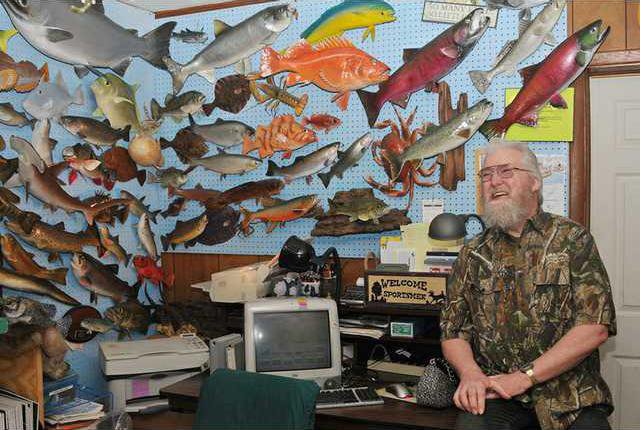
Frankie Thompson, the president of the National Taxidermy Association, talks about what he and his organization do for the taxidermy industry.Oakwood taxidermist Jerry Howard hesitantly says he's an artist.
His craft involves tanning hides and stuffing rather than putting paint on a canvas, but he does apply paint to fish.
Then, it's the art of mounting the animals in a life-like, natural way.
Some may see taxidermy as a gruesome way to commemorate a kill. Others may consider it a way to honor the animal, forever preserving it in a space on the wall.
But no matter what your feelings are about taxidermy, there are specialists such as Howard who work to preserve the integrity of the animals.
And that, said Howard's counterpart in North Carolina, Frankie Thompson, is as much an art as anything else you could put on your wall.
"In this day and time it is considered a wildlife art," said Thompson, who has a taxidermy business in Franklin, N.C., and is the president of the National Taxidermy Association, the largest such organization in the country.
Howard, who owns AARRKK Taxidermy, attended the Northwestern School of Taxidermy in Omaha, Neb., and in 1979 moved to Juneau, Alaska, where he worked at the Alaska State Museum for 10 years.
He was the taxidermist for the museum and helped develop a natural history gallery. Five years ago he came back to Oakwood with his wife, Renate.
"I worked at the state museum for 10 years and then I was a classroom teacher the rest of the time," Howard said. "The museum has a natural history gallery focusing on Southeast Alaska, so I was involved in the design of that."
Howard reconstructed brown bears, bald eagles, fish and whales for the museum.
There are many misconceptions about the taxidermy industry.
For example, many people wonder if the eyes are original and why the mount doesn't smell like rotting animal, according to Howard.
"The eyes are replaced with glass eyes, or acrylic eyes nowadays," he said. "Some people think that on a deer head that the meat is still in there ... on the deer they have forms that are available. So I take measurements off of the deer from the corner of the eye, to the tip of the nose and from the nose to the back of the skull and a couple measurements around the neck and then I pull out my catalogue and go through and find one that fits its size and also in the position the person wants it in."
While Howard waits for the synthetic form to match the deer measurements, he tans the hides and cuts off the antlers. When the mount is picked up by the customer they know that the hide and the antlers are original.
"I generally tell folks the skin has to be removed, the skin has to be tanned, mounted up, because the skin is wet when you put in on there and then it has to dry," he said. "All of the mammals, the birds, have the real skin, on the fish there is an option of using the skin or going with a fiberglass replica which lasts longer."
To create art from hunted animals or fish, Howard said, the process actually starts with the hunter.
"Well, in the case of fish I generally recommend that people give me a call if they are not going to bring it right over," said Howard, who began his career in 1965. "If it's not going to be fresh, wrap it up in a wet towel, put it in a plastic bag and put it in the freezer until they can bring it. If it's a whole fish, don't clean it, the gutting or that sort of thing ... leave it as is and bring that."
The freezer rule applies to small game and birds, too.
"Basically put it in a plastic bag and freeze it, if they can't bring it over right away," he said.
Deer are prepared a little differently since hunters usually gut and skin the animal themselves.
"Deer heads and big game most people will skin it out and they take the skin off of the body up to a little bit below the neck and cut through the meat ... they bring me the head with the antlers," Howard said.
Years of experience, such as Howard's, are one factor hunters should look for when finding a taxidermist. Plus, Thompson added, word of mouth is good, too.
"You have to do your research," he said. "You have to find somebody that does have a shop or is working out of the garage and then go in and look at the work and see if it looks like an animal and meets your satisfaction. Find out what his waiting period is ... visit several taxidermists."
A good waiting period for your mounted animal is about six months, according to both Thompson and Howard.
"Some will take a year or more," Thompson said. "It could be too much work, it could be that they aren't utilizing their time efficiently ... but if it takes more than a year then the customer forgets what the animal really looked like and they lose interest."
Thompson said another way to find a taxidermist is through the National Taxidermy Association.
"The NTA has a certification program, and across the country we have roughly 160 people that are actually certified in the taxidermy certification program," he said. "Out of those there's only about 20 to 25 that are certified in all four categories: birds, mammals, fish and reptiles."
But Chad Dale found his taxidermist the old-fashioned way - through the grape vine.
"Well on the taxidermy side you want to try and find somebody to make it look like it's real, like it's alive," said Dale, a Flowery Branch resident.
Dale has taken deer and trout to Woody's Taxidermy in Baldwin, but chose Antler Creations in Toccoa for a bear he recently shot on Nov. 23, with his grandfather, Jack Bowen, in Blairsville. The bear was a 415-pound female.
"I'm having a shoulder and a head mount and the rest of it will be into a rug," said Dale, who will spend about $1,200 for the creation. "Usually a deer head is around $350."
But then again, the price is never a dealbreaker.
"For a professional product," Thompson said, "I charge a professional price."
And when you get that prized animal mounted, there's periodic maintenance you have to follow, too.
"On the animals that have hair on them, I recommend taking a soft cloth and brushing it the way of the hair," he said. "If you take a hair dryer and blow it off ... Basically that's it. Dust the antlers ... I don't recommend that people clean the eyes with anything because it could damage the finish."
Over the past 40 years that Howard has been a taxidermist he has found his niche in the industry with fish. He said he really feels like he's leaving his mark after painting a fish mount.
One of his favorite fish he has mounted over the years is a peacock bass.
"It's kind of exotic with the red fins," he said. "It's from Central and South America."